You will need a few minutes to read this – it's long and perhaps a cuppa will help!!
Israel is thought provoking indeed… and a bit difficult for us to “get our heads around.” Writing this blog has been quite the challenge and we thank you for being there to read it – we’ve grown from the exercise.
We never thought we’d get to Israel. The usual reasons people go seem to be related to religion, culture, tradition, etc. but, for us there never was that fit. A friend planned an extended visit to study in Safat, and then we learned that another couple were going to be there at the same time, and they asked if we’d like to join them to tour the country. Being with folks for whom Israel was special and important would give us the opportunity, to absorb some of the pleasure and meaning it held for our friends and others. It brought Israel “up a notch” on our list and it turned out to be a very rewarding trip.
It may be that our doubts originally were due to a feeling that Israel would be very intense – and it was. There is so much deep history, so many stories, so much to see and to understand, so many stresses on this small country.
We were there for 15 days. We began our time in Tel Aviv and ended it in Tel Aviv, but in between we drove all over the country, with the exception of several days in Jerusalem when we were without a car. We were exceptionally fortunate to be with 3 really wonderful friends from Tucson; LynnRae Lowe, an artist, had been in Safat (Tsfat) for several weeks studying kabalistic Judiasm, Karen Zittleman, who had never been in Israel before and is not Jewish, and her significant other, David Sadker, brought up in the Jewish tradition who had been a few times but not in recent years.
As we said, we spent our first night in Tel Aviv (could have been any city in the world on the water), admiring the wonderful beach and amazed at how international the city is. We rented a car the next AM and drove to Safat, (in the northeast part of this country that is the size of New Jersey!) meeting up with our friends and a guide, Adam, to hear about the city The road signs are in Arabic, Hebrew and sometimes in English – this kept us on our toes throughout our visit.
 Safat has a very large and popular artist quarter – LynnRae (http://www.lynnraelowe.com/) will be represented there soon – and where we spent some interesting time as well.
 It is the city where studying the Kabbalah is a tradition and so is filled with very religious folks.

We had an exceptional Friday evening, first attending, a service in a very old synagogue, then Shabat dinner with a really remarkable family – one son studying to be a rabbi, another a sharpshooter in the army, who each brought a friend. There were other children and families – about 20 people around the table (the Mom, chief cook and bottle washer, MickyG from California, said every Friday is a Thanksgiving in this house). LynnRae had rented an apartment from them and became very good friends with MickyG and we certainly benefitted!!! The conversation and being part of the ritual was really wonderful. WOW!

Saturday, we left Safat and headed west to the Mediterranean. Stopping at Akko for a lunch by the water and to see the crusader ruins, then heading for Haifa where we were blown away by the beauty of the B’Hai Gardens, by their beliefs and by the monument to the founder. http://www.bahai.org/
 From Haifa, LynnRae and the two of us went on to Natanya for a couple of nights, while the others headed to Jerusalem. From Netanya we explored the ruins of Megiddo (with much ancient history and identified as the site of the final battle between the forces of good and evil at the end of time) and those of Caesarea, the huge seaport built on prior ruins by Herod where we had a most delicious lunch!
 Then we joined Karen and David in Jerusalem for a few nights. What an amazing city. K & D had engaged a truly fine guide, Nadav, and the five of us spent a day together with him trooping through the warrens of the old city focusing on the Jewish history. After a goodbye dinner our 3 companions left Israel and then we spent another day with Nadav….but before we talk about that – here’s a story for you….

While at the Western Wailing Wall (which is divided) the Davids (Sadker and Cooper), and Nadav went into the men's side while Karen, LynnRae and Susan went into the women's side. While there, David Sadker had a tefillin tied on and David Cooper told them about our friend, Steve Schram who is a chiropractor/acupuncturist in NYC, and is very interested in the relationship between the tefillin and the meridians. Nadav remembered reading something about that during his studies. Susan sent an intro email to Steve and Nadav....and had a response from Nadav. The articles he refers to below were written by Steve – one of them is here: http://www.drstevenschram.com/tefillin.pdf
“Susan Shalom
Hope you and David are well.
I have not yet contacted your friend but wanted to inform you that I have The Source and will be getting to read it real soon.
Check these articles I found in my research of my second year... :)”
Another WOW!!
There is so much to say about Jerusalem. Some highlights are:

A tunnel dug by archeologists along the 1500’ retaining wall built by Herod (of which the Western Wall is the above ground part) – people are inside the tunnel praying at that part of the wall all the time.
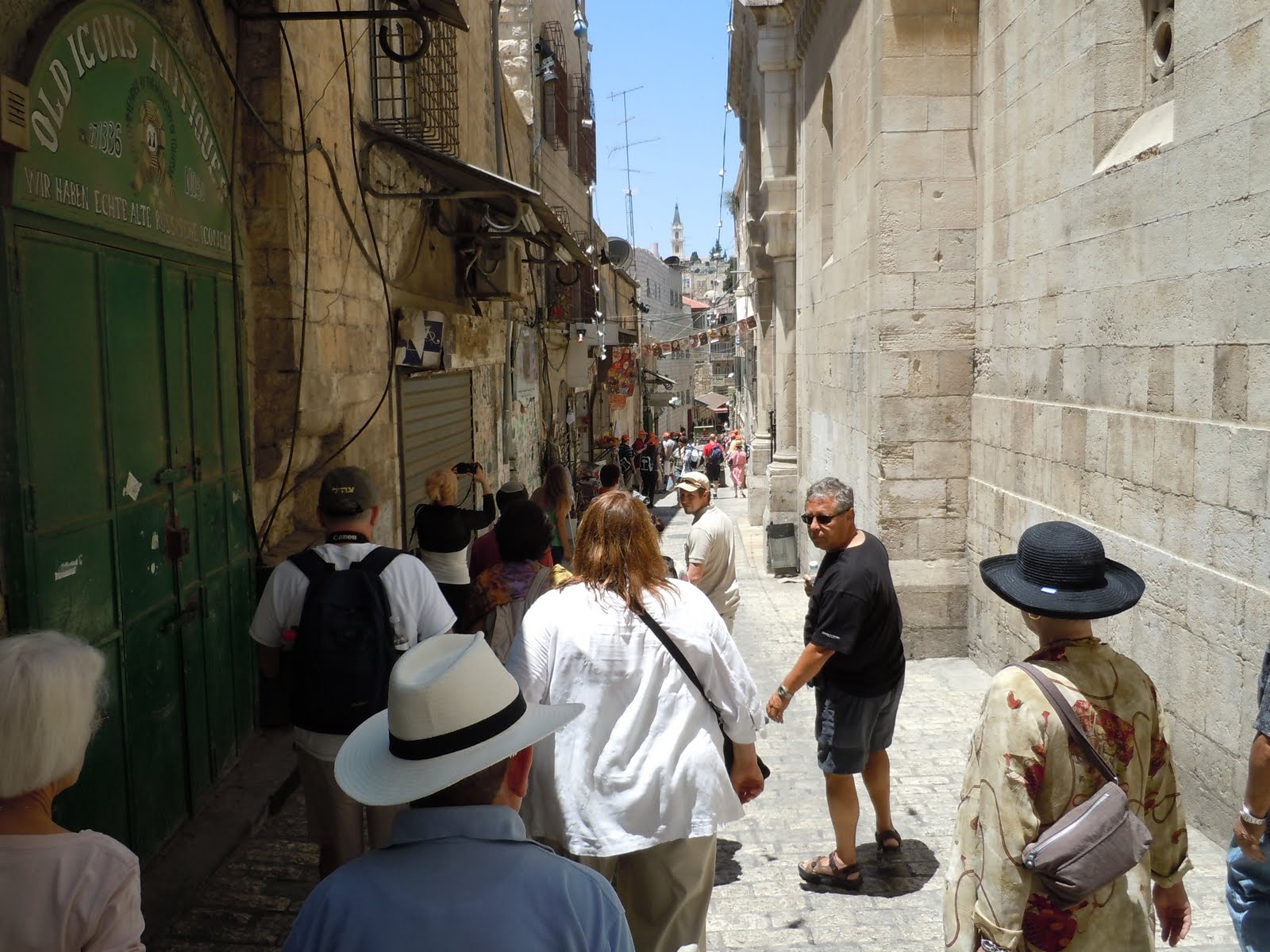
The Jewish, Muslim, Armenian and Christian Quarters of the Old City, full of shops, cafes, and monuments, much of it below ground, crowded and super busy. This photo was taken on the Via Dolorosa - the path that Christ followed after being condemned to death. The real path is probably far below this, buried by eons of rubble and dirt, but the Church has put the stations of the cross on the buildings along this route and so this is the "official" trail.

The Mount of Olives - there are many stories about this place, most religions have some sort of tie to it...but, one story we heard is that Jesus ascended to Heaven from here and when he returns to this dimension, he will return here to enter Jerusalem through the gate in the wall at the bottom of this Mount, but he cannot walk through a cemetery, so to keep him out of the city the mountain is filled with burials (???).

The Temple Mount and Dome of The Rock.
We were so fortunate to be here on a day when the public was able to enter this area - it is restricted to 2 days a week and then only for a few hours - non-Muslims are never allowed inside the Mosque - it is a remarkable building and a remarkable place.

The Church of the Holy Sepulcher - occupied by several religious groups, there are many things going on in this building....theoretically it houses the cave that Christ was placed in, a piece of the cross, the slab that he rose from, the rock the cross was placed in, and on and on. Many branches of Christianity claim it and that sometimes creates unseemly issues - but mostly it's cool. To quote A Historical Tour of the Holy Land by B. Ratzer..."Possibly the most complicated of the holy places is the Church of the Holy Sepulcher, also known as the Church of the Resurrection. The key to the church is held by a Muslim family who open the doors in the morning and close them in the evening. One representative each from the Orthodox, Catholic and Armenian churches are permitted to remain in the Church overnight. In addition to these three churches, the Copts, Syrian Jacobites and Abyssinians all have a small part of the church."
And there is so much more! Clearly Jerusalem was the highlight in a trip of seemingly endless highlights!

The last chunk of our time was spent at a dude ranch (yes, a dude ranch) overlooking the north end of the “Sea” of Galilee for two days (it is really a large lake). From there we toured around the Galilee area. There were more ruins to see and at one of them – Kursi – we sat for a long time feeling extraordinarily peaceful at what has been identified as a magnetic power point - (strongest under this rock) (http://www.geobiology.co.il/Articles/High_Energy_2.asp). We were also treated to watching a group of young, beautiful and playful Japanese tourists amid the wonderful flowering trees and bushes.

The Church of the Beatification was another wonderful stop.
We had a delicious lunch in the Little Tiberas Pub ion the resort town of Tiberas and were waited on by a pretty cool gal from California. It was amazing how many people we ran into who had transplanted themselves to Israel from the U.S.

Hearing the planes flying over and seeing tanks on the road, everywhere young people, in the army, carrying automatic rifles, brought home the reality of the situation in Israel....and the conditions under which people live. The problems are not simple and the solutions even more elusive. On some level we knew this, but now it is more real to us - having the opportunity to talk with Israel's people face-to-face was really great - one really good reason to travel.
On our way back to Tel Aviv we got caught in nasty traffic in Nazareth (wonder if the donkey traffic was as bad…), made a stop in Zippori to visit more impressive ruins, then a stop in Netanya to pick up David’s cell phone left there by accident a week or so before, and finally back to Tel Aviv. We had a great apartment at the Diaghilev Hotel and walked a bunch, particularly along Rothschild Blvd, which is filled with Bauhaus buildings. That night we had champagne with our Indian dinner then, in the morning, flew back to London via Rome arriving late at night…..we will tell you about our next adventure on the British Isles next time.

Much love, many hugs and WOW!!


